Started January 2010 [by Jack Thurgar]

This is a scrapbook dedicated to the study of London's weeds and the wild places where they grow. Wildcornerz also looks at the languages, cultures and mythologies that develop in these cracks.


What is a Wildcorner?

A Wildcorner is a term referring to a piece of land that has been left to grow wild in a man made landscape. To be a true Wildcorner, the land has to be restricted from public access. Many are hidden from public view altogether. A common type of wildcorner is referred to by govements and local authorities as a 'brownfield site'.

Wildcorners and corridors* are dotted all over the capital and vary in content, depending on their location and history. In this blog we focus particularly on the Wildcorners of south east London.

* Wildcorridors are networks of pathways that run through the city and facilitate the propagation and growth of weeds. Many are restricted from public access such as railway embankments and urban rivers. In the suburbs, footpaths such as the Green Chain connect public green areas by a network of alleyways and passages that skirt between houses and private land. It could be argued that these are also wild corridors.


Urban and Suburban Weeds

By the term 'weeds' we are of course referring to the cities wild plants and flowers. But their are also two other weeds that grow in the city.

'Graf' like its botanical relation, has many families and strains. Both of these weeds can often be found together, sharing many qualities including their adaptive nature and unregulated status. Both in many cases, originally entered and populated the city using the railway network.

Another 'weed' that historically flourishes in London is invisible and uses the tops of tower blocks to propagate. Pirate radio like its weed relatives, grows away from the public eye and is constantly adapting to exploit these same gaps across the cities FM radio spectrum, fighting and flourishing in-between the commercial stations.

© Copyright of Wildcornerz. All rights reserved. For enquiries please contact: wildcornerz1@yahoo.co.uk
Showing posts with label Internal Networkz / Wild Corridorz. Show all posts

Monday, 29 September 2025

Wild corners connected

                        
This guy sets himself the challenge to cross Greater London without using any roads. Some of these Youtuber geo adventures can seem a little gimmicky at times but what is created here is fascinating. 
He maps a route using larger green spaces and in between these he navigates, trespasses an internal network of edges, alleys and water ways through the city and suburbs. 
See him passing through Lewisham in a section of the Ravensbourne. 


Monday, 1 September 2025

The Swamp [Vol 1]


Here is the full length version of my film The Swamp. A poetic documentary about my favourite wild corner, hidden on a secluded train embankment close to my childhood home. It is the place I was first told about the legend of the Lewisham Natureman and shown his scratched crown tag.

The film is made from a collage of footage I filmed there over the last 20 + years. It is the first of a series exploring different aspects of the Swamp. This first episode examines the mysterious pond and the unnamed stream.

Malcom Appleby's studio


One of many gems from BBC Archive's Youtube account. Lovely footage of Malcom Appleby's home and studio built in a derelict train station on a long discontinued line.  

Monday, 28 April 2025

Devils Steps Portal

Proper original Lewisham Wildcornerz stuff ... 
A post on Facebook that caught my eye recently.
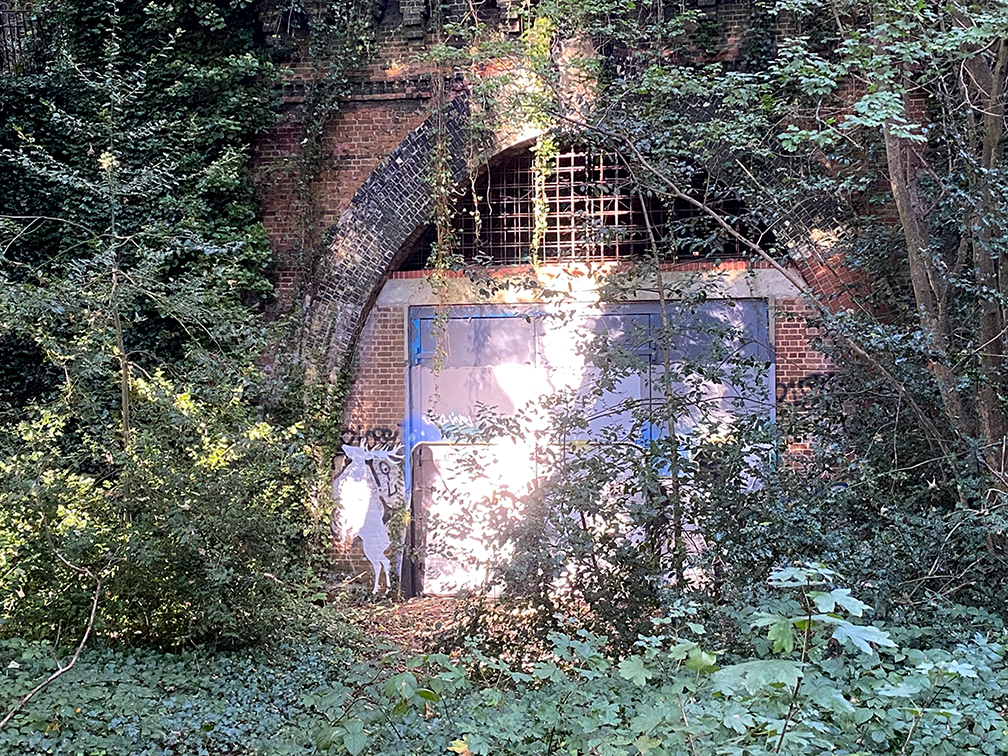
 Devil's steps was an access point for local children to climb onto the railway which led to a huge disused gravel pit a little way along the tracks. This is obviously where the road name Granville Park came from.
 'A paradise for adventurers'. 
An old Lewisham Natureman white stag can sill be seen behind the creeping plants, calling into a portal at the bottom of Devils Steps.
 [My mum remembers accessing the same pit through the rail bridge further along known as Lover Lane, where the stag beetles would fly in the summer.]

Oil painting of Devils steps which used to hang on my grandmother's wall. 


Wednesday, 8 November 2023

Wild Corners on the Western Borders

Exploring Lewisham's far South Western border, in search of wildness.
Behind some flats in the shadows, a dark path can be seen through scrub and pine trees.
It continues and starts to climb into steps upwards, away from the visibility of the road.


The trail then steadily falls into a small woodland valley; a remaining shred of the ancient Great North Wood. Remains of the Crescent Wood Tunnel start to surface through the ivy.


The Tunnel cuts into the Sydenham hill. The portal is to a long forgotten internal network eventually leaving Lewisham at its furthest south western boundary and entering Crystal Palace. 
The tunnel first opened in 1865 to facilitate a train line which ran from Nunhead to serve the great exhibition. The tunnel was design by the same architect who designed the palace; Joseph Paxton. 
A section of the line was painted in a landscape by Camille Pissarro during the days of steam.
[1954, Pic Subterranea Britannica]

After many years of struggling, the fire that destroyed the Crystal Palace also sealed the fate of the line, as it declined further and finally closed in 1954. 
For several years there was talk of the tunnel being used as part of the Bakerloo line southern extension but the plans were scrapped.

[1980, Pic Disused Stations]

The tunnels were still accessible up to the 1980’s and used by local kids until some younger local children went missing and police searched the tunnels. No children were found but the council sealed them off with heavy gates after this.
[2005 Pic Subterranea Britannica]

On approach to the Tunnel, a familiar shape can be seen through the trees. 

The stag can be seen feeding on hind legs to the left of the entrance.
[2023, Wildcornerz]


Sources: Subterranea Britannica, Disused Stations, Portals of London, 'Sydenham and Forrest Hill Through Time' - Steve Grindlay, History of the Borough of Lewisham - Duncan Leland, Lost Lines of the South - Nigel Welbourn


Sunday, 15 October 2023

Bunking - a Mini Workshop

This is a mini workshop I ran as part of a two day online event for Chisenhale art studios, the Alt-MFA and Into the Wild alternative art programs:

Local hiding places. 
If you were a kid, where would you bunk school? 

 Workshop by Jack Thurgar [WILDCORNERZ]

A workshop focussing on hiding places, spaces away from authority and the public eye.

This is a quick exercise in imaginative thinking.

The workshop aims to create a small five minute window out of our studio practice

to focus-in and meditate on a specific place. 


Participants are encouraged to think like a child, reinterpreting the local area to find their own hiding place. Think about how it stimulates all senses. Describe its location and geography. Why did you choose this place for bunking?

As a group we will spend 5 minutes drawing a quick sketch and/or write a few sentences about the place from memory/imagination.

Participants then spend the last few minutes sharing back to the group. 

Sketch by Michael Davies [workshop participant]


Tuesday, 11 October 2022

Wild Cornerz Show this week in Peckham

 Im showing my new video 'The Swamp' this week as part of a group show named after this very blog. The video is the first of a new series made of footage filmed at the infamous swamp over the last 20 years. Accompanying the video I am showing my shrine to the Swamp [pictured below]. 

Im exhibiting alongside three other local artists; Andrew Finch, Tobias and Ed Carter who's work also explores wildness in someway. 

Heres a small feature about the show on Radical Art Review: https://www.radicalartreview.org/post/floods-riots-and-pirate-radio-exploring-lewisham-s-forgotten-corners

A Shrine to the Swamp 

Still from 'The Swamp' by Jack Thurgar

Wild Cornerz is showing at Satterlite Store, Holdrons Arcade, Peckham [Thurs 13th - Saturday 15th Oct].

Andrew is screening his film 'The Love Below' Featuring myself and Ed Carter in the river Quaggy, on the closing night at 6pm.

Wednesday, 12 February 2020

Lewisham Natureman Catford Bridge Sighting

These photos were taken some years ago now [maybe 5 or 6] featuring Lewisham's own wandering spirit of wild places. Under Catford Bridge it is seen walking alongside the Ravensbourne, as the river passes underground. Thank you to P.M for the tip off.


.. and again some years later, disappearing and reappearing.


Wednesday, 15 October 2014

UK Graff Videos Doc's of the Past

'Tags' Graffiti vid doc, featuring 1980s/90s London Graff


'Graffiti Wars' [Sheffield Graff Doc]


'Bombing' 1987 Documentary about Graff and Hip Hop culture in Briton.


'Writers' London Graffiti 1990s

A few awkward moments there, in the meeting about the commission..
"Play it cool Rodders, .. play it cool son!"

'Colourful Barz' - Train writers Skam, Skream and Nois of FDC and JKS crews. Josh Piehl talks about his sentencing and prison experience.

Monday, 16 June 2014

New distant sighting of the Wild Walker

The deer shaped spirit was spotted from Fordmill Road in Catford. [Thanks go to Timbo for his eagle eye.] It is the last road bridge over the Ravensbourne before it is joined by the River Pool and flows into and partially under central Catford, running by the train line. He is virtually hidden at the end of the straight, walking out of sight. 


Friday, 16 May 2014

Road Patterns

This animated map of London elegantly traces the mazes of roads forming patterns like nerve fibres of a human brain or the arteries veins and capillaries of some great beast. Layers of networks build up and adjust through out the capitols history, from the ancient roads left by the Romans through to the urban sprawl of the city today.

Friday, 11 April 2014

Following the Middle Kid Brook

 Running Past blog trace the small stream as it winds its way from Shooters Hill through Kidbrooke. It joins the Quaggy in Lee Green from a pipe in the brick work.
Here.

Wednesday, 13 November 2013

Some press and net cuttings on Lewisham's white deer


{The Telegraph}


{Curriculum Enrichment magazine}


(Lib Dem's magazine 'In focus')

Here are a collection of some newspaper cuttings and web articles on The Lewisham Natureman from earlier in the year. The press coverage was sparked from liberal democrat councillor Cllr Chris Maines campaign to save the mural on Cressingham road. This has been already painted on and can be seen in the press pictures. [Notice the black paint over the mouth of the deer and over some of the background.]
In all these articles The Lewisham Natureman is spoken of as the name of the artist and not of the stag spirit itself.  Some have also reported the deer, as different members of a heard rather than the same solo spectre.
Not much is known about the stag or who created it but we do know [by looking at the writing underneath the mural piece on Cressingham road] is that it is some kind of tribute to the Lewisham Natureman and not made by 'him'. 
This is a name already know to us at Wildcornerz through our research and documentation of South East Londons' derelict gaps. The Lewisham Natureman was the name attached to a small carved symbol of a crown [in the same style as the boroughs logo] with a dandy-lion growing through it, though some report it as a Thistle or a Daisy. 
This tiny symbol was found in various wastelands and wild spots around the borough of Lewisham from the late 1970s to the end of the century. Sometimes they would be accompanied by a date and would normally be hidden away.
Due to their mystery, they became the subject of many urban legends amongst local children who would play in these wild corners. The basis of the myth / legend links the symbols directly to the wild places they were found and suggest their maker is some kind of shamon or wild man who lives in or uses them. Other versions describe him more as a 'spirit of wild nature', a 'familiar' to the weeds who helps them to grow and protects the wild corner.
The myth was also know to some in other communities that use these spaces, such as the local graffiti crews, travellers, urban fishers, the homeless and street drinkers. Fences are jumped and bars are bent to access these cracks and corners of the city. These fringe communities of London can still be found using these 'wastelands' spaces no matter how temporary the stay. Some of these would have used what was know as Common land centuries ago and the many bomb sites and edgelands around London in the last century. Now even these gaps; 'commercial wastelands' / 'brownfield sites' are becoming increasingly more transitory, due to the London Assembly's current building strategy for the capital. The core idea being to build on land within the city, rather than expanding further out.   
The deers are not signed and maybe their maker is not what is important.
We at Wildcornerz like to believe the stag is the Lewisham Natureman, in animal form; an embodiment of this same spirit of wild places in Lewisham.   

Sunday, 13 October 2013

The London Perambulator (full length documentary)

A fascinating and fondly made portrait of the writer and deep topographer; Nick Papadimitriou. He takes us with him on walks to some of his favourite spots, while describing the landscape he also reflects upon his life and work. The film contains interviews with Will Self, Ian Sinclair and Russell Brand.

Saturday, 9 March 2013

Strange Shack Appears in Wildcorner - SE12


 I recently went though a shoe box full of old camcorder tapes, which i thought were lost. To my absolute joy I found this grainy footage, which i thought I had taped over a while back [and berated myself many times for doing so.]
It features a mysterious looking shack, which appeared sometime in the early Summer of 2010.
It looks like it is made from a jumble of found materials and stands alone in a large sealed off piece of wasteland [a Wildcorner] on Barring Road, SE12, in the London borough of Lewisham.
What was it for? Who had made it?
 The materials possibly could have all been salvaged from within the corner.
You can see a longish narrow window facing across the wasteland and a small door at the back. A shelter made by a vagrant perhaps? Or maybe some kind of 'viewing hut' for observing the wild nature in the Corner?
 The reason the footage is so special to me is that I suspect this to be the work of the infamous city explorer Solomon Wild. The shack serving as a base to work in, while studying the corners wildlife and graff.
I used to travel past regularly on the 261 bus, who's top deck overlooks the site and I was sure I'd never seen it there before. I filmed it with my old camcorder on three separate passes of the bus.
 The shack stayed there for the rest of the Summer until one day in mid Autumn, I saw from the bus, that the shacks roof and two of its side panels were twisted and broken.
My guess is that it was caused by unusually high winds that swept through the city a few weeks previous. Over the next few months i watched it slowly deteriorate, becoming again part of the wildcorner it was possibly built from.
It looked like whoever lived in or used it, had long gone. This leads me to think the shack was only intended to be a temporary base, to use just for the Summer.
I wish now that I had got inside the corner somehow, to inspect the wreckage.


Friday, 23 November 2012

New spotting of the solitary spirit

In a particularly hidden spot below a bridge, sheltered by over hanging trees,
 The Lewisham Natureman can be found drinking from a tributary of the River Quaggy [possibly the Middle Kid brook.] in Lee Green, Lewisham.


Monday, 19 November 2012

River of Words


 The River of Words competition was a local poetry competition in 2006.
Here is the winning entry.

Quaggy
Quaggy: hidden behind back gardens and privet.
Brickwalled, low. A road over which rivulets
Quietly slide inches deep. Culverted,
A sluice. A ditch to pitch the stolen bicycle,
Scoured and vacuum-sucked by tractors in autumn.
But while we looked away, below the station,
The grey-backed bobbing birds have come to stay.
The balance on bricks, pick the debris, chatter safely
Shaded by buddleia; run along its concrete rim;
Occupy their own secluded mountain stream.
And in the upturned shopping trolley
The mitten crabs raise woolly claws,
Wait for rainstorms, are flung towards the Thames,
Shed their skins that float on foam and confluence,
Then scurry uphill home to lurk in drains.
Paint and oil gutters in -
Slicks, sticks, dilutes, decays.
Summer comes. The lime trees drip their glue and greenflies.
Ducks swim by from parks to ponds. Seeds, butterflies,
Are carried from woodland to wasteland. And we pass by.

Emily Hay