Started January 2010 [by Jack Thurgar]

This is a scrapbook dedicated to the study of London's weeds and the wild places where they grow. Wildcornerz also looks at the languages, cultures and mythologies that develop in these cracks.


What is a Wildcorner?

A Wildcorner is a term referring to a piece of land that has been left to grow wild in a man made landscape. To be a true Wildcorner, the land has to be restricted from public access. Many are hidden from public view altogether. A common type of wildcorner is referred to by govements and local authorities as a 'brownfield site'.

Wildcorners and corridors* are dotted all over the capital and vary in content, depending on their location and history. In this blog we focus particularly on the Wildcorners of south east London.

* Wildcorridors are networks of pathways that run through the city and facilitate the propagation and growth of weeds. Many are restricted from public access such as railway embankments and urban rivers. In the suburbs, footpaths such as the Green Chain connect public green areas by a network of alleyways and passages that skirt between houses and private land. It could be argued that these are also wild corridors.


Urban and Suburban Weeds

By the term 'weeds' we are of course referring to the cities wild plants and flowers. But their are also two other weeds that grow in the city.

'Graf' like its botanical relation, has many families and strains. Both of these weeds can often be found together, sharing many qualities including their adaptive nature and unregulated status. Both in many cases, originally entered and populated the city using the railway network.

Another 'weed' that historically flourishes in London is invisible and uses the tops of tower blocks to propagate. Pirate radio like its weed relatives, grows away from the public eye and is constantly adapting to exploit these same gaps across the cities FM radio spectrum, fighting and flourishing in-between the commercial stations.

© Copyright of Wildcornerz. All rights reserved. For enquiries please contact: wildcornerz1@yahoo.co.uk
Showing posts with label Lewisham Landmarks. Show all posts

Wednesday, 8 November 2023

Wild Corners on the Western Borders

Exploring Lewisham's far South Western border, in search of wildness.
Behind some flats in the shadows, a dark path can be seen through scrub and pine trees.
It continues and starts to climb into steps upwards, away from the visibility of the road.


The trail then steadily falls into a small woodland valley; a remaining shred of the ancient Great North Wood. Remains of the Crescent Wood Tunnel start to surface through the ivy.


The Tunnel cuts into the Sydenham hill. The portal is to a long forgotten internal network eventually leaving Lewisham at its furthest south western boundary and entering Crystal Palace. 
The tunnel first opened in 1865 to facilitate a train line which ran from Nunhead to serve the great exhibition. The tunnel was design by the same architect who designed the palace; Joseph Paxton. 
A section of the line was painted in a landscape by Camille Pissarro during the days of steam.
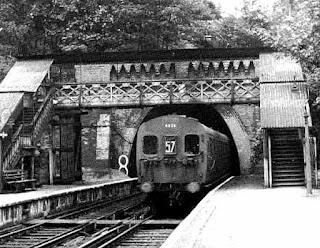
[1954, Pic Subterranea Britannica]

After many years of struggling, the fire that destroyed the Crystal Palace also sealed the fate of the line, as it declined further and finally closed in 1954. 
For several years there was talk of the tunnel being used as part of the Bakerloo line southern extension but the plans were scrapped.
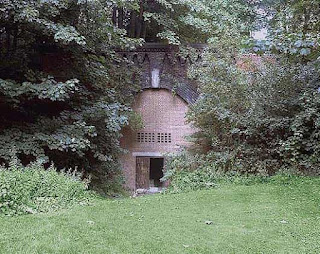
[1980, Pic Disused Stations]

The tunnels were still accessible up to the 1980’s and used by local kids until some younger local children went missing and police searched the tunnels. No children were found but the council sealed them off with heavy gates after this.
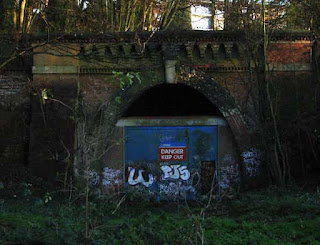
[2005 Pic Subterranea Britannica]

On approach to the Tunnel, a familiar shape can be seen through the trees. 
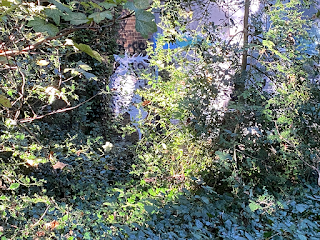
The stag can be seen feeding on hind legs to the left of the entrance.
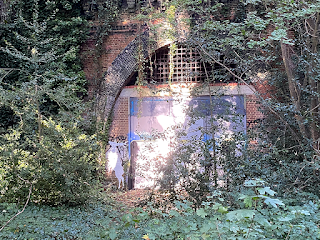
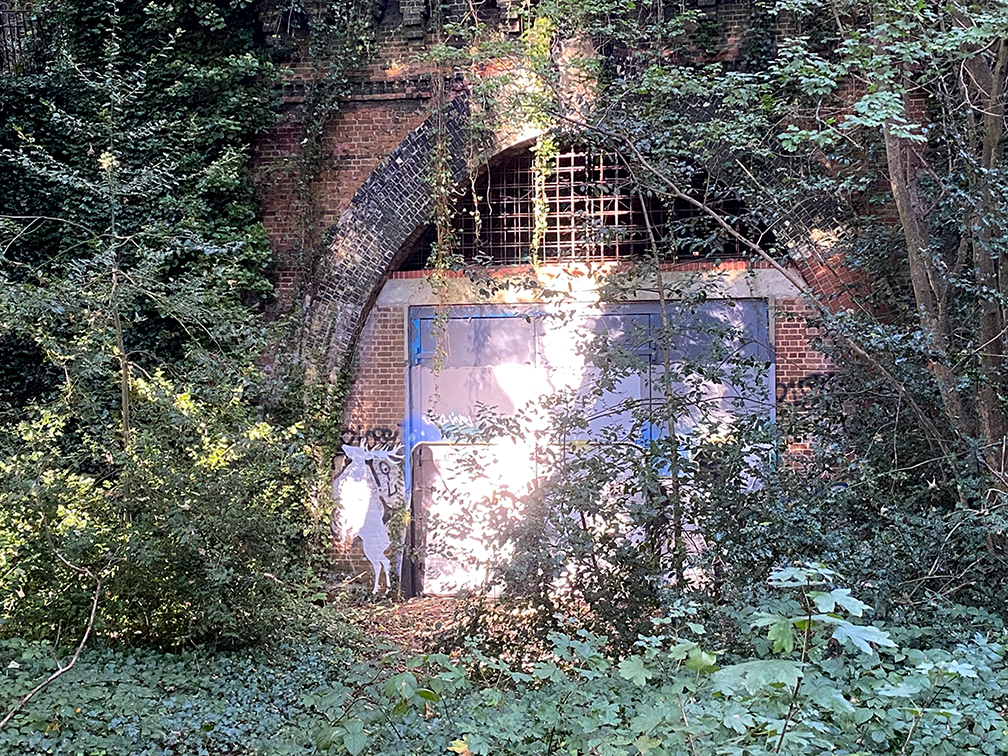
[2023, Wildcornerz]


Sources: Subterranea Britannica, Disused Stations, Portals of London, 'Sydenham and Forrest Hill Through Time' - Steve Grindlay, History of the Borough of Lewisham - Duncan Leland, Lost Lines of the South - Nigel Welbourn


Wednesday, 12 February 2020

Raids on Lewisham Pirates [Archive]

Article from 2001
One location mentioned is Aragon tower, formally the tallest residential block in Europe. Also formally owned by Lewisham council until it was sold off to Berkeley Homes in 2006 and turned into luxury apartments. It was at an early phase of the 'gentrification' of Deptford. This is documented in the BBC series 'The Tower: A Tale of Two Cities'
Mentions Nigerian pirate; N Power and Uk Garage pirate; Silkroom FM.


Friday, 20 April 2018

A Portrait of Mr Pink [The Pink House, Lewisham]

Some of you may have seen this already but had to document it here for the archive. If you haven't, this is the beautiful short 'A Portrait of Mr Pink' by Helena Appio. Like the house itself, The film had a mythical status to me, as I had been trying to see it for years. For Lewisham residents The Pink house has been a local landmark for decades and a source of wonder and childhood myths.
The film is beautifully shot and uses the Mr Pink's own crackly recordings for a perfect natural soundtrack.
Mr Brenton Samuel Pink sadly passed away last year. Its so good that the film was made and gives us a glimpse into Mr Pink's world. For me, it has only added to the legend of the Pink House and its eccentric creative inhabitent.
The house is still there at present, standing in darkness at the top of Lonepit Vale.

Monday, 6 January 2014

Lewisham's epic Shopping Centre Mural - 1996 [B. Williams]

The incredible mural at the back of Lewisham Shopping Centre was unveiled back in 1996 but still certainly deserves a mention in Wildcornerz. Bruce Williams and Gary Phillips's stunning piece of work is vibrant education resource to passers by. 
 Among many historic scenes there are the three arms of the metropolitan boroughs of Lewisham and Deptford and the amalgamated London borough of Lewisham [featuring the white stag.]


96 - The green dragon on a post, at Sydenham Wells Park was the sign of one of Sydenham’s medicinal springs.