Started January 2010 [by Jack Thurgar]

This is a scrapbook dedicated to the study of London's weeds and the wild places where they grow. Wildcornerz also looks at the languages, cultures and mythologies that develop in these cracks.


What is a Wildcorner?

A Wildcorner is a term referring to a piece of land that has been left to grow wild in a man made landscape. To be a true Wildcorner, the land has to be restricted from public access. Many are hidden from public view altogether. A common type of wildcorner is referred to by govements and local authorities as a 'brownfield site'.

Wildcorners and corridors* are dotted all over the capital and vary in content, depending on their location and history. In this blog we focus particularly on the Wildcorners of south east London.

* Wildcorridors are networks of pathways that run through the city and facilitate the propagation and growth of weeds. Many are restricted from public access such as railway embankments and urban rivers. In the suburbs, footpaths such as the Green Chain connect public green areas by a network of alleyways and passages that skirt between houses and private land. It could be argued that these are also wild corridors.


Urban and Suburban Weeds

By the term 'weeds' we are of course referring to the cities wild plants and flowers. But their are also two other weeds that grow in the city.

'Graf' like its botanical relation, has many families and strains. Both of these weeds can often be found together, sharing many qualities including their adaptive nature and unregulated status. Both in many cases, originally entered and populated the city using the railway network.

Another 'weed' that historically flourishes in London is invisible and uses the tops of tower blocks to propagate. Pirate radio like its weed relatives, grows away from the public eye and is constantly adapting to exploit these same gaps across the cities FM radio spectrum, fighting and flourishing in-between the commercial stations.

© Copyright of Wildcornerz. All rights reserved. For enquiries please contact: wildcornerz1@yahoo.co.uk
Showing posts with label Local History. Show all posts

Monday, 13 October 2025

Common Crown


Made this little intervention the other day up on Whitefield’s mount, which is the name given to the island of scrub growing wild on Blackheath. It is named after the 18th century Anglican preacher who would deliver sermons from it to audiences of thousands. 


Before this though, for centuries the patch was known as ‘Wat Tyler’s Mound’. Apparently speeches were made up here to the rebel encampments before they proceeded their march into the city, at the Peasants Revolt of 1381. 

From reading more about the mound on the excellent runner500 blog, it looks like it has been used as a gathering point by other rebellious political movements as well, such as the Cornish rebels before the battle of Deptford bridge, the Chartists and the Lewisham Suffragette’s.


Today it is now a quieter corner of the heath.

The bench there is known to some as ‘Ed’s bench’ in memory of a former class mate at my secondary school. It faces out on to a crater that becomes a pond in winter. 

In the summer the remains of rough sleeping can usually be found in the bushes of the mound, the thickets of gorse providing shelter from the wind and a veil from the main road. 

The detritus in the grass there reflects the mounds relatively isolated location and unregulated ‘wild’ character;

Beer cans, condoms, vapes, weed baggies and fag ends…

and the feathers of crows, who watch over the wild island from the solitary birch tree.


Monday, 1 September 2025

The Swamp [Vol 1]


Here is the full length version of my film The Swamp. A poetic documentary about my favourite wild corner, hidden on a secluded train embankment close to my childhood home. It is the place I was first told about the legend of the Lewisham Natureman and shown his scratched crown tag.

The film is made from a collage of footage I filmed there over the last 20 + years. It is the first of a series exploring different aspects of the Swamp. This first episode examines the mysterious pond and the unnamed stream.

Wednesday, 8 November 2023

Wild Corners on the Western Borders

Exploring Lewisham's far South Western border, in search of wildness.
Behind some flats in the shadows, a dark path can be seen through scrub and pine trees.
It continues and starts to climb into steps upwards, away from the visibility of the road.


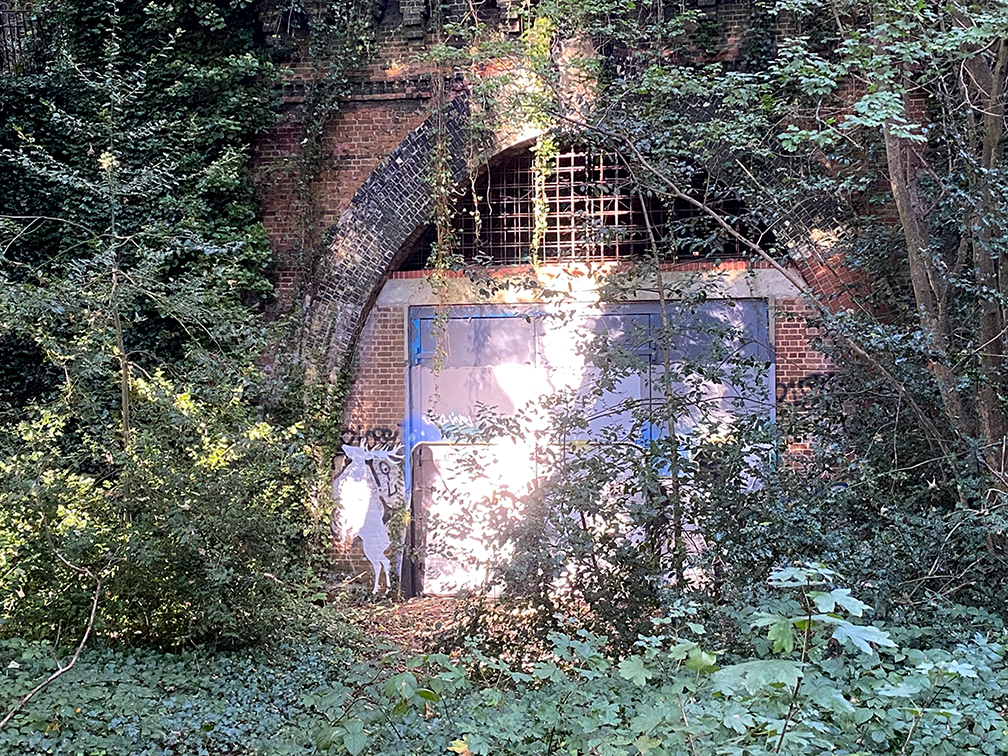
The trail then steadily falls into a small woodland valley; a remaining shred of the ancient Great North Wood. Remains of the Crescent Wood Tunnel start to surface through the ivy.


The Tunnel cuts into the Sydenham hill. The portal is to a long forgotten internal network eventually leaving Lewisham at its furthest south western boundary and entering Crystal Palace. 
The tunnel first opened in 1865 to facilitate a train line which ran from Nunhead to serve the great exhibition. The tunnel was design by the same architect who designed the palace; Joseph Paxton. 
A section of the line was painted in a landscape by Camille Pissarro during the days of steam.
[1954, Pic Subterranea Britannica]

After many years of struggling, the fire that destroyed the Crystal Palace also sealed the fate of the line, as it declined further and finally closed in 1954. 
For several years there was talk of the tunnel being used as part of the Bakerloo line southern extension but the plans were scrapped.

[1980, Pic Disused Stations]

The tunnels were still accessible up to the 1980’s and used by local kids until some younger local children went missing and police searched the tunnels. No children were found but the council sealed them off with heavy gates after this.
[2005 Pic Subterranea Britannica]

On approach to the Tunnel, a familiar shape can be seen through the trees. 

The stag can be seen feeding on hind legs to the left of the entrance.
[2023, Wildcornerz]


Sources: Subterranea Britannica, Disused Stations, Portals of London, 'Sydenham and Forrest Hill Through Time' - Steve Grindlay, History of the Borough of Lewisham - Duncan Leland, Lost Lines of the South - Nigel Welbourn


Sunday, 15 October 2023

Bunking - a Mini Workshop

This is a mini workshop I ran as part of a two day online event for Chisenhale art studios, the Alt-MFA and Into the Wild alternative art programs:

Local hiding places. 
If you were a kid, where would you bunk school? 

 Workshop by Jack Thurgar [WILDCORNERZ]

A workshop focussing on hiding places, spaces away from authority and the public eye.

This is a quick exercise in imaginative thinking.

The workshop aims to create a small five minute window out of our studio practice

to focus-in and meditate on a specific place. 


Participants are encouraged to think like a child, reinterpreting the local area to find their own hiding place. Think about how it stimulates all senses. Describe its location and geography. Why did you choose this place for bunking?

As a group we will spend 5 minutes drawing a quick sketch and/or write a few sentences about the place from memory/imagination.

Participants then spend the last few minutes sharing back to the group. 

Sketch by Michael Davies [workshop participant]


Thursday, 10 November 2022

The Swamp [Vol 1] Extended Trailer - NEWNESS!

This is a trailer for my first video in a new series. 

The videos explore the infamous Swamp; a secluded piece of wild land in Lewisham and are made from footage I filmed there over the last 20 years.

In this first chapter I look at the mysterious pond and the unnamed stream.


Run time of full film: 24 mins


Friday, 20 April 2018

A Portrait of Mr Pink [The Pink House, Lewisham]

Some of you may have seen this already but had to document it here for the archive. If you haven't, this is the beautiful short 'A Portrait of Mr Pink' by Helena Appio. Like the house itself, The film had a mythical status to me, as I had been trying to see it for years. For Lewisham residents The Pink house has been a local landmark for decades and a source of wonder and childhood myths.
The film is beautifully shot and uses the Mr Pink's own crackly recordings for a perfect natural soundtrack.
Mr Brenton Samuel Pink sadly passed away last year. Its so good that the film was made and gives us a glimpse into Mr Pink's world. For me, it has only added to the legend of the Pink House and its eccentric creative inhabitent.
The house is still there at present, standing in darkness at the top of Lonepit Vale.

Tuesday, 21 January 2014

Revisit to Wildcorner Beacon, Isle of Dogs

I first discovered this special corner back in 2007. Since then i have asked around and searched on the net for information about the beacon but to with no joy.
The tower stands tall above the thick weeds arounds it. Ivy crawls up its sides and it rules the corner with a silent majesty. From the street the sealed off corner looks like a fortified other world and the beacon, a relic from this other place and time. Perhaps it is a lighthouse of the wild, signalling at night to the underground, to the spirits that can read its code. Or perhaps it holds some kind of mysterious unknown function or posses an ancient magic.
 After a recent failed attempt at finding the corner again, I went back home and put my thinking cap on. Thanks to some detective work, I got a rough idea of where it was. Then I searched the area on good ol' 'street view' and to my delight I found it. I was excited to see the land was still wild and the beacon still standing. Was this still the case though? The google camera car could of passed there years ago for all I knew.
 So i was equally amazed to find the corner on a field trip over the river a few days later, still fenced off and untouched. 
Well .. apart from one thing.


Sadly the lantern at the top was not insight. I found the remains of it underneath thick Brambles and Knot Weed as I searched around the base. 
It could of been the Buddleia gradually prised it up and then the strong winds finally dislodged it.
Or was it the work of human hands?


 Once i got home that evening I searched on the net again for the beacon. Now I knew what to look for I soon came across a blog by a local guy who was asking for information about it. 
He had consulted old maps of the area and pointed out the beacon is 100 mtrs away from the water edge. He found the corner would of been at the edge of an area known as 'Popular Dry Dock' which was used approx up until the 1950's and then in the 1970's renamed Empire Wharf. His theory was that the beacon would of been used to guide ships into dock. 
 This though a well thought out theory, looks like it was just a theory as comments under his post suggest. It looks as though the area was once part of the Christ Church garden. When the police station was built sometime in the 80's the land was going to be turned into their car park, but a local man protested against this. This man was the legendary Ted John's the Island campaigner who was at the forefront of its unilateral declaration of independence in 1970. They say he campaigned with local residence for a community garden and won. The beacon apparently was a kind of folly in the garden in reference to the areas maritime history. 
 If this true, it is kind of disappointing that the little lighthouse isn't Victorian and was never used as an actual beacon.
 The tower still has its place in the history of the the area though and could be looked at in another way as a reminder from the past, standing as a beacon for people power and community spirit.


Monday, 6 January 2014

Lewisham's epic Shopping Centre Mural - 1996 [B. Williams]

The incredible mural at the back of Lewisham Shopping Centre was unveiled back in 1996 but still certainly deserves a mention in Wildcornerz. Bruce Williams and Gary Phillips's stunning piece of work is vibrant education resource to passers by. 
 Among many historic scenes there are the three arms of the metropolitan boroughs of Lewisham and Deptford and the amalgamated London borough of Lewisham [featuring the white stag.]


96 - The green dragon on a post, at Sydenham Wells Park was the sign of one of Sydenham’s medicinal springs. 

Wednesday, 1 January 2014

Old Wildcorner Beacon - Millwall

I was going through my phone photo archive and found these pictures from 2006. I took these on a field trip around the Isle of Dogs. On the south of the island known as Cubitt Town, I found an old fenced off wildcorner.
 In the middle of the corner I found this old structure shrouded in weeds. 
It appears to be an old beacon for the river [which is now obscured by a new housing estate.]
 A rare relic from a by-gone era of the thames and the east end.
 I cannot find any record of it online. I am going to try the Island History Archive in Millwall.
I assume it has been demolished and the land, long since built on. I will revisit and post a report back soon.


Wednesday, 13 November 2013

Some press and net cuttings on Lewisham's white deer


{The Telegraph}


{Curriculum Enrichment magazine}


(Lib Dem's magazine 'In focus')

Here are a collection of some newspaper cuttings and web articles on The Lewisham Natureman from earlier in the year. The press coverage was sparked from liberal democrat councillor Cllr Chris Maines campaign to save the mural on Cressingham road. This has been already painted on and can be seen in the press pictures. [Notice the black paint over the mouth of the deer and over some of the background.]
In all these articles The Lewisham Natureman is spoken of as the name of the artist and not of the stag spirit itself.  Some have also reported the deer, as different members of a heard rather than the same solo spectre.
Not much is known about the stag or who created it but we do know [by looking at the writing underneath the mural piece on Cressingham road] is that it is some kind of tribute to the Lewisham Natureman and not made by 'him'. 
This is a name already know to us at Wildcornerz through our research and documentation of South East Londons' derelict gaps. The Lewisham Natureman was the name attached to a small carved symbol of a crown [in the same style as the boroughs logo] with a dandy-lion growing through it, though some report it as a Thistle or a Daisy. 
This tiny symbol was found in various wastelands and wild spots around the borough of Lewisham from the late 1970s to the end of the century. Sometimes they would be accompanied by a date and would normally be hidden away.
Due to their mystery, they became the subject of many urban legends amongst local children who would play in these wild corners. The basis of the myth / legend links the symbols directly to the wild places they were found and suggest their maker is some kind of shamon or wild man who lives in or uses them. Other versions describe him more as a 'spirit of wild nature', a 'familiar' to the weeds who helps them to grow and protects the wild corner.
The myth was also know to some in other communities that use these spaces, such as the local graffiti crews, travellers, urban fishers, the homeless and street drinkers. Fences are jumped and bars are bent to access these cracks and corners of the city. These fringe communities of London can still be found using these 'wastelands' spaces no matter how temporary the stay. Some of these would have used what was know as Common land centuries ago and the many bomb sites and edgelands around London in the last century. Now even these gaps; 'commercial wastelands' / 'brownfield sites' are becoming increasingly more transitory, due to the London Assembly's current building strategy for the capital. The core idea being to build on land within the city, rather than expanding further out.   
The deers are not signed and maybe their maker is not what is important.
We at Wildcornerz like to believe the stag is the Lewisham Natureman, in animal form; an embodiment of this same spirit of wild places in Lewisham.   

Sunday, 13 October 2013

The London Perambulator (full length documentary)

A fascinating and fondly made portrait of the writer and deep topographer; Nick Papadimitriou. He takes us with him on walks to some of his favourite spots, while describing the landscape he also reflects upon his life and work. The film contains interviews with Will Self, Ian Sinclair and Russell Brand.

Saturday, 12 October 2013

The DBC [Dread Broadcasting Corporation] - Great Pirate Radio Docs - part .. whatever 2

This West London station is considered to be the first black owned pirate station in Europe. Transmitting a mixture of political and social debate together with black music from various genres.
It has a little gem of an animation to go with it too!


Tuesday, 1 October 2013

Blue Boro Documentory - Lewisham

Finally found the full length version of this lovingly crafted film documenting Lewisham's urban music scene; Grime, Road Rap, R n'B etc. Youngers and olders talk about the boroughs black musical history and its lineage to the scene today.
 The doc also looks at the connection between 'the blue's' musical movement and the boroughs street gangs. It is interesting that the Woodpecker estate is constantly referred to as a birth place of the scene. Its one remaining tower stands tall on the landscape and is home to the Ghetto Boys, a street gang from New Cross who originally formed back in the mid to late 1970's.
 Theres a lot of talking heads in this doc but some interesting reflections and some solid bars from the likes of Big Cakes, Status, SRG [look for the old faded 'CASE' graffiti before his section, a local punk band active in the 1980's] and of course the mighty P Money among others.
 Shame Kozzie and Dot Rotten didn't feature and it would of been nice to see more of Saxon and the connection to those early days which Skeme touches on in his interview.
 Never the less, its great that this slept on scene has been documented in this way and younger mc's / producers are given a sense of history and context to the music they are making today.
 Blue boro stand up!


My Ends - Rapman Ft King Zion [Blue Borough]
 Why did they close down Yates?

Tuesday, 28 May 2013

Lewisham's White Deer - Seen by the Old Catford Dog Track


Here are the photos from the new sighting of the solitary spirit, on the edge of one of the borough's larger wildcornerz. He can be seen from Ladywell Park, stooping to look through a whole in the old fence that boards off the old Catford Stadium. 

The former dog track was opened in 1932 and became a famous landmark, being highly regarded in the sport. It was well known for its buzzing atmosphere and infamous Boxing Day races. In later years, its audience dwindled as betting shops opened and the sport became less popular. The managing operator Wembley closed it down in 2003. 
 In 2005 a huge fire gutted the stadium's buildings and tore around its seating platforms. Its is now fenced off from public access [as well as being cut off at either side by two train lines] and lays quietly for the wild to reclaim. 
Among many other weeds, tall bushes of Pampas Grass [a native of South America], grow from the ground where the track used to be.


  ... and over the fence...